





















Most runners know what it’s like to feel great for the first couple of miles, only to watch their pace unravel later in the run. This isn’t because you’re unfit or a bad runner; it's because you haven’t nailed your pacing yet.
That’s where a progression run comes in. One of the most effective runs you can add to your training plan.
A progression run starts at an easy effort and gradually builds in intensity as the run unfolds. Rather than trying to hold one pace from start to finish, these runs are about teaching your body and mind to keep pushing, even when fatigue begins to creep in.
The result is a workout that improves pacing awareness, perceived effort, and endurance, while giving you the confidence to run faster without a complicated structured run or endless watch-checking.
You'll find progression runs in training plans for beginners learning how to judge effort, marathon runners preparing for the demands of race day, hybrid athletes building running endurance, and experienced runners building aerobic fitness in high-mileage programs.
The session is highly adaptable, making it just as effective during a 5K training block as it is during marathon preparation.
In this guide, we'll explain exactly what a progression run is, why it works so well, how to pace one properly, and the different progression run workouts you can use to become a stronger, more controlled runner.
What Is A Progression Run?
A progression run is a run that starts at an easy effort and gradually increases in intensity as the session goes on. The key word here is progression. Think of yourself as progressively overloading - not by adding reps or weight, but by gently shifting gears while you’re already moving.
Progression runs differ from other popular types of running, such as tempo runs, where you hold a fixed pace, or intervals where you alternate between hard and easy. The point is to build continuously, gradually upping your effort until you finish at your strongest sustainable pace.
That effort can be guided by pace, heart rate, or even just perceived effort (if you like to run tech-free). Most runners find RPE (rate of perceived exertion) the easiest way to stay honest, especially outdoors, where terrain, wind, and heart rate can constantly tweak your splits.
As the run progresses, your effort should gradually build. For example, if your route includes two hills, the second should feel more challenging than the first because you're intentionally working at a higher intensity by that point in the session.
The overall goal is to build endurance, speed, and aerobic capacity by learning how to run efficiently as fatigue builds, rather than letting it dictate your form and pace.
How Does A Progression Run Work?
At its core, a progression run is about restraint at the start and confidence at the finish. You’re deliberately holding back early so you can unlock speed later. It can feel like you’re running too slow to begin with, especially if you’re used to holding pace.
A simple structure for a 5k progression run might look like this:
Section: Effort
Starting 1km: Easy conversational pace
Middle 2- 4 km: Steady moderate pace climbing
Final 1km: Comfortably hard effort
The best progression runs feel fluid from start to finish. If someone looked at your splits afterwards, they should see a steady progression rather than sharp spikes in pace. The aim is to build rhythm and momentum throughout the run, not to keep on suddenly accelerating.
The benefits? Throughout the run, you’re training your body to:
Resist the urge to start too fast
Maintain form as fatigue builds
Increase speed efficiently without breaking rhythm
Finish with control rather than survival mode
A good progression run should feel like you’ve finished strong by the final kilometre, not like you’ve been emptied out by it. You’ve shown yourself you can keep pushing, even as things start to feel tough.
Or, as many coaches [like xyz] like to put it, “you’re learning to shift gears gradually instead of flooring the accelerator from the start”.
Why Progression Runs Are So Popular
One reason progression runs are so popular among runners is that they offer many of the benefits of harder workouts without the same recovery cost. Because the intensity builds gradually, your cardiovascular system and muscles have time to warm up naturally before working at higher efforts. This often makes progression runs feel more manageable than running the same distance at a fixed tempo or race pace. It’s something you can relax into, which can make it feel less taxing.
Many runners also use progression runs early in a training block. For example, a marathon runner might begin with a workout that gradually builds from an easy pace to marathon pace or slightly faster over the course of a long run. Later in the training cycle, that progression may be replaced with longer sustained efforts at marathon pace. This allows runners to get their legs turning at a decent pace without feeling completely depleted.
Progression runs can also help train one of the most important skills in racing: finishing stronger than you started. You’ve probably heard a running coach at some point tell you that you should end as strongly as you start, and this is true on race day. A lot of runners aim to run even or negative splits on race day, meaning the second half of the race is completed at the same pace or slightly faster than the first. Learning to increase pace while maintaining good form, relaxed breathing, and mental focus can make this feel more natural when it matters most.
Another reason runners enjoy progression runs is the variety. Instead of locking into one pace for an entire workout, the gradual changes in effort can make the run feel more engaging while still delivering a strong training stimulus. Switch it up, stay focused.
Why Are Progression Runs Effective?
Aerobic Efficiency
By spending most of the session at aerobic intensities before gradually increasing effort, progression runs allow runners to accumulate quality training volume while still exposing the body to faster paces later in the workout. This combination can help improve running economy and endurance performance without the recovery demands of an all-out speed session.
It’s essentially one way to train your heart, lungs, and muscles, even if you’re a seasoned runner. A 2026 review on negative-split pacing highlighted improvements in lactate threshold, running economy, VO₂ kinetics, and pacing awareness as key adaptations developed through progression runs and split-pace training [1].
Fatigue Management
One of the biggest gains comes from learning to run well while tired, with researchers identifying progression runs and fast-finish workouts as effective methods for developing fatigue resistance and pacing control through controlled exposure to increasing effort levels [1].
As the effort builds, your body has to maintain form, cadence, and coordination under increasing stress. That’s exactly what happens in the final stages of a 10K, half-marathon, or marathon. This teaches runners to maintain technique, rhythm, and decision-making under conditions that more closely resemble race day.
Mental Toughness
Progression runs teach runners to stay resilient as things get uncomfortable during the final stages of a workout or race. You’re constantly holding yourself back early, then trusting yourself later. That shift builds confidence in your ability to negative split races and stay composed from start to finish.
Reduced Injury Risk
Because progression runs begin at an easy effort, they give your body time to gradually warm up before intensity increases. The steady rise in heart rate, blood flow, and muscle activation helps prepare muscles, tendons, and joints for harder running, reducing the stress that can come from sudden pace changes. This gradual build-up may also improve movement efficiency and leave runners feeling less sore than workouts that start aggressively.
Race-Day Pacing Practice
If you’ve ever gone out too fast in a race and regretted it at halfway, this is the antidote. Progression runs reinforce the same restraint-and-build strategy that many successful endurance athletes use in competition. Learning to hold back early before increasing effort later can improve race execution and reduce the likelihood of a dramatic slowdown in the final stages.
The studies back it up, too: one study examining negative-split pacing in marathons found that a gradual build is associated with improved glycogen conservation, delayed fatigue, reduced cardiovascular drift, and stronger finishing performances in endurance events [3].
Structured vs Effort-Based Progression Runs
There are two main ways to run progression sessions, and both have value depending on your training environment.
Structured progression runs
Structured progression runs follow pre-planned pace targets, timed segments, or distance-based blocks. Rather than relying solely on feel, the workout is guided by specific metrics, giving runners a clear framework to follow from start to finish.
For example, a structured progression run might consist of 10 minutes at an easy pace, 10 minutes at a steady pace, followed by 5 minutes at a comfortably hard effort. Each increase in intensity is planned in advance, making it easy to monitor progress and execute the session consistently.
This approach works particularly well for runners training towards a specific race goal, as well as those using a treadmill where pace can be controlled precisely. Because the structure remains the same each time, it's also a useful way to track fitness improvements over the course of a training block.
Tip: Many structured progression runs are suitable for runners who know their running pace, but probably not recommended for beginners who are still working out the difference between easy pace and steady pace.
Effort-based progression runs
Consider these the more intuitive of the two, guided by feel rather than strict numbers. You simply increase effort gradually as the run unfolds, removing the need to check your watch constantly.
This version is more adaptable to hills, heat, wind, or fatigue. It’s often better for beginners because it removes pressure around exact pacing and encourages body awareness instead.
Which One Should You Choose?
Choose Structured if you are peaking for a specific race (like a marathon) and need to groove your goal race pace into your muscle memory.
Choose Effort-Based during base-building phases, on days when you feel slightly "off," or when running hilly courses where pace becomes less relevant than exertion.
Common Types Of Progression Runs To Try
Beginner-Friendly Progression Run
If you're new to progression runs, it’s best to keep things simple. Forget about strict pace targets; you’re just trying to learn how to gradually increase your effort throughout a run without starting too fast or running out of steam.
Beginner progression runs are typically shorter and based on effort rather than specific race paces. Focus on finishing, feeling strong and in control, with each section slightly faster than the last.
Workout Examples
Easy-to-Steady Progression Run
20 minutes at an easy pace
10 minutes at a steady pace
5km Progression Run
2km easy
2km moderate
1km strong finish
20 Minute Progression Run
10 minutes at an easy pace
5 minutes at a steady pace
5 minutes at a comfortably hard pace
These simple runs help develop pacing awareness, aerobic fitness, and confidence in finishing the run strong despite having less in the tank. Once you're comfortable with these formats, you can gradually progress to longer runs that incorporate marathon pace, tempo efforts, or fast-finishing segments.
Thirds Progression Run (The Classic)
This is the most common progression run structure and a great starting point for beginners. The run is divided into three equal sections, with each section becoming progressively harder.
First third: easy
Second third: steady
Final third: comfortably hard
Workout Example
9km Progression Run
3km easy conversational pace (RPE 3-4)
3km steady pace (RPE 5-6)
3km comfortably hard effort (RPE 7-8)
This version is brilliant for learning pacing control without overthinking splits. It teaches you what “easy” and “steady” actually feel like, which is a skill many runners skip past.
Fast Finish Progression Run
This is a staple in marathon training and one of the most race-specific progression formats. Most of the run is easy, then the final section ramps up into marathon pace or slightly quicker. It mimics the mental and physical grind of the final stages of a marathon, where efficiency matters more than raw speed. The objective isn't simply to run fast at the end. It's to practise maintaining good running mechanics, efficient pacing, and mental focus when fatigue has already accumulated.
Workout Example
20km Fast-Finish Long Run
16km easy pace
4km at marathon pace
Beginner Version
8km easy
1km steady finish
This workout is especially popular during marathon training because it replicates the feeling of picking up the pace when glycogen stores are low and the legs feel heavy — one of the biggest challenges on race day [2]. Fast finish progression runs teach runners to stay patient early, conserve energy, and finish strong rather than hanging on for survival.
If you're prone to starting races too aggressively and fading in the later miles, this is one of the most valuable progression runs you can include in your training plan.
Mile-By-Mile Progression Run
This version increases intensity with each split, usually by kilometre or mile. You judge this run by your perceived effort for each mile. It’s simple, but it sharpens pacing awareness. It’s also very beginner-friendly. You start to understand exactly what small increases in effort feel like over time, which translates well to race execution.
Workout Example
Distance: Pace
Mile 1: Easy
Mile 2: Slightly quicker
Mile 3: Moderate
Mile 4: Strong finish
Long Progression Run (Easy → Moderate → Fast)
The long progression run takes the principles of a progression run and applies them over a much longer duration. Instead of spending most of the run at one pace before finishing fast, the effort gradually builds across the entire session.
This workout is commonly used by experienced half-marathon and marathon runners because it develops endurance, pacing discipline, and fatigue resistance simultaneously.
A well-executed long progression run should feel controlled throughout. The pace gradually increases as the run unfolds, but the effort remains sustainable. By the final section, you're running close to marathon pace or slightly quicker while already carrying fatigue from the earlier miles.
They also provide an excellent opportunity to practise fuelling, hydration, and pacing strategies under realistic conditions.
Workout Example
18km Long Progression Run
6km easy pace (RPE 3-4)
6km steady pace (RPE 5-6)
6km marathon pace to comfortably hard effort (RPE 7-8)
For marathon runners, this workout often serves as a bridge between traditional long runs and race-pace sessions, combining many of the benefits of both into a single workout.
How To Pace A Progression Run Properly
The biggest skill in a progression run isn’t speed; it’s restraint.
Most runners naturally start too fast because it feels easier to go all in when you’re feeling fresh. But that usually leads to the dreaded stall or fade mid-run. For progression runs, the goal is quite the opposite: feel slightly undercooked early so you can build into strength later.
A successful progression run should feel almost too easy at the beginning. You should finish the opening section feeling like you're capable of running much faster. That's exactly the point.
As fatigue gradually builds, your effort should increase in small, controlled increments. Think going from a 5”40km/h pace to 5”30km/h. The transitions shouldn't feel abrupt. By the final section, you'll be working hard, but still running with good form and control.
One useful way to think about pacing is that the run should become progressively more challenging without ever feeling frantic. If you're sprinting the final kilometre or gasping for air at the finish, you've probably increased the pace too aggressively.
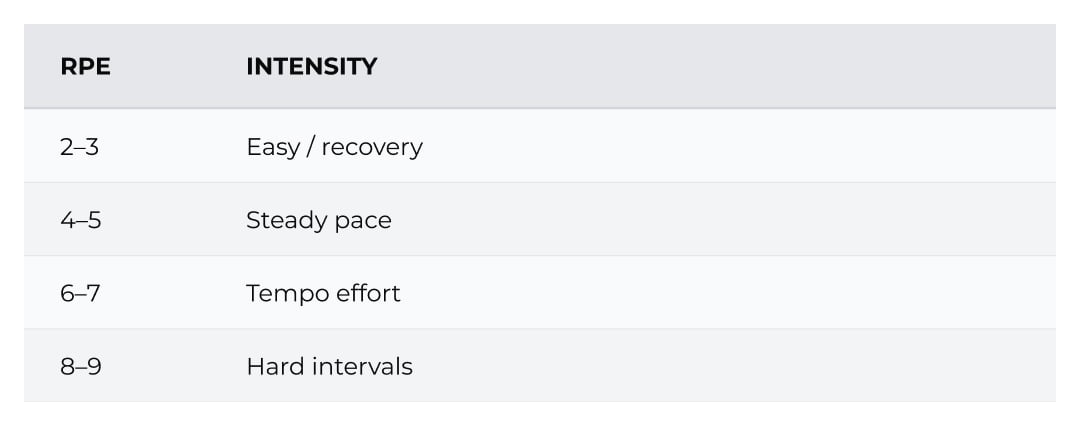
Using the RPE scale, a progression run might be paced like this:
Easy effort → RPE: 3-4
Steady pace → RPE: 5-6
Hard Finish → RPE: 7-8
For runners using heart rate, the majority of the run will sit within aerobic zones before gradually progressing towards threshold effort near the end.
Common Progression Run Mistakes
Starting Too Fast
The biggest mistake you can make in a progression run is starting too fast; it defeats the whole point of the run. The excitement and energy you have at the start line can easily result in starting too strong. Doing this stops the run from actually being progressive, and it becomes a struggle to maintain speed.
Turning The Finish Into A Sprint
The final section should be hard, but it shouldn't resemble a finishing kick at the end of a race.
Progression runs are designed to build sustained effort. Think the final third of the run at a faster pace rather than just the last 100m. Sprinting the final few hundred metres often indicates that the earlier sections were too conservative.
Aim for a strong, controlled finish rather than a last-minute rush.
Increasing Pace Too Aggressively
Progression runs are about gradual increases in effort. You don’t want to be jumping from a jog directly into a tempo run. This can spike your heart rate rapidly and trigger a buildup of lactic acid that can be hard to recover from. Large jumps in pace can also make the workout feel disjointed and difficult to manage. Instead, stick to small, steady increases, which in turn produce better pacing habits.
Running Every Progression Run Hard
Not every progression run needs to finish at threshold pace. Many runners fall into the trap of trying to turn every session into a fitness test, but over time, you’re only screwing yourself over with accumulated fatigue and compromised recovery. One of the main purposes of progression runs and training plans altogether is that you’re consistently getting the miles in, not trying to hit PBs all week.
Not Making Weather Or Elevation Adjustments
Progression runs should be guided by effort, not just pace, and this means slowing down when the conditions call for it. Heat, humidity, wind, and hills can all make maintaining target splits unrealistic. On challenging routes or in warm conditions, slow the pace down and focus on gradually increasing effort rather than forcing specific pace targets.
When Should You Add Progression Runs To Your Training?
Progression runs can be used throughout the year, but they become particularly valuable during race preparation phases. For most runners, one progression run per week is enough to see meaningful benefits without interfering with recovery.
They're especially useful during:
Marathon training blocks
Half-marathon preparation
Base-building phases
Hyrox and hybrid training programmes
Training cycles focused on pacing improvements
Because progression runs already contain moderate-to-hard efforts, it's usually best to avoid placing them immediately before or after interval sessions.
They pair particularly well with:
Easy mileage days
Long runs
Recovery-focused weeks
The exact placement will depend on your overall training volume, but most runners find success scheduling them midweek between easier sessions.
FAQs
Are progression runs good for beginners?
Yes. Progression runs help beginners develop pacing awareness and effort control without the complexity of interval sessions. They also teach runners how different intensity levels should feel, which becomes valuable during race training.
How hard should the finish feel?
The finish should feel comfortably hard, not maximum effort (RPE 10). You should be working noticeably harder than at the start of the run, but still running with control and good form. Most runners should finish feeling challenged rather than completely depleted.
Are progression runs good for marathon training?
Progression runs are one of the best tools in your marathon training toolbox. They help marathon runners get the miles in, practise maintaining pace under fatigue, and develop the discipline required for effective race-day pacing.
Unlike tempo runs, which focus on holding a sustained threshold effort, or marathon pace runs, which require you to lock into your goal pace from the outset, progression runs teach you how to gradually increase effort as fatigue builds.
This makes them particularly effective for marathon preparation, where success often comes down to managing your effort early and maintaining pace in the later miles.
How often should I do progression runs?
For most runners, one progression run per week is sufficient. This provides enough stimulus to improve pacing and endurance while allowing adequate recovery between harder workouts.
What is the difference between a tempo run and a progression run?
Progression runs and tempo runs are often confused because both involve sustained running at moderate to hard efforts. However, they serve slightly different purposes within a training plan.
Tempo runs challenge your ability to hold a consistent effort near your lactate threshold.
Progression runs place greater emphasis on pacing, judgement, and gradually increasing effort under fatigue.
Neither workout is inherently better; they both have a place in your training cycle.
Can progression runs replace interval sessions?
Not entirely. Intervals remain one of the most effective ways to develop speed and VO₂ max. Progression runs are better suited to improving endurance, pacing awareness, and fatigue resistance, but you’ll benefit the most from using both workouts within a balanced training plan.
Final Thoughts
Progression runs prove that getting faster isn't always about running harder. Often, it's about learning when to be patient.
Every progression run begins with a decision to hold back. While your legs feel fresh and your watch is tempting you to speed up, you're choosing control over ego. On race day, that patience pays off later, when you're still moving smoothly while others might be hanging on.
Over time, progression runs teach skills that carry into every aspect of your running. You become more aware of your effort, more confident in your pacing, and better equipped to deal with fatigue when it inevitably arrives. Instead of fearing the later stages of a race, you learn how to lean into them.
So whether you're training for your first 5K, chasing a marathon PB, or simply looking to become a stronger runner, progression runs offer a practical way to build endurance and race-day confidence in the same session.
Start easier than you think you need to. Let the pace build. Then finish with purpose.
References:
[1] Grivas, G.V., Safari, K. and Hemmatinafar, M. (2026) 'Developing negative split pacing in endurance athletes: practical guidelines and training models', Frontiers in Physiology, 17, 1741125. Available at: https://doi.org/10.3389/fphys.2026.1741125 (Accessed: 17 July 2026).
[2] Grivas, G.V. (2025) 'The physiology and psychology of negative splits: insights into optimal marathon pacing strategies', Frontiers in Physiology, 16, 1639816. Available at: https://doi.org/10.3389/fphys.2025.1639816