


















Deadlifting twice your bodyweight? Impressive.
But lifting your entire body against gravity, like pulling off a muscle-up or holding a human flag? That’s next-level strength, control, and athleticism.
It’s called calisthenics, and while it’s a form of bodyweight training, it’s definitely not boring. From gravity-defying holds to explosive movements that look almost superhuman, calisthenics proves you don’t need a gym full of equipment to build serious strength.
Now, if you’ve ever seen someone do a muscle-up, handstand push-up, or human flag and thought, “I could never do that,” think again.
Because here’s the truth: every advanced athlete started with the basics.
By building a strong foundation through beginner calisthenics movements, you’ll develop full-body strength, mobility, and control, which will lay the foundation for more advanced exercises.
Whether you’re bored with your current routine and ready for a challenge, training from home with minimal equipment, or inspired by the sheer strength of calisthenics athletes, we’ve got you covered.
We’ll cover how to start calisthenics, including the best beginner calisthenics exercises, expert training tips from Zach Watson - PT and Strength and Conditioning Coach at the Gymshark Lifting Club, and how to warm up.
What Is Calisthenics?
The term calisthenics comes from the Greek words ‘Kalos’ and ‘Stenos’, which translate as beauty and strength. It sounds fancy, but the premise of this training method is very simple: Calisthenics uses bodyweight and gymnastic-style exercises, using bodyweight and gravity as resistance [1].
Even if the concept sounds completely new, you’ve probably encountered calisthenics before without even realising it: Pull-ups, push-ups, and even sit-ups are a form of calisthenics, although advanced trainers will aim to master the L-sit, muscle-up, handstand push-up, and planche, to name a few.
‘You don’t need a lot of equipment to do callisthenics. You can do your calisthenics workout at home, in the park, or in your local gym,’ explains Zach. ‘It’s great to have a pull up bar and a free wall, but you don’t need machines. You can get away with just a resistance band to help with assisted exercises.’
@calisthenics.bypaulina Steaks, avocado and eggs changed the game🥩🥑🍳 Nutrition tracked with @tryfithub 💪🏽 #calisthenics #handstand #calisthenicstraining #calisthenicmovement #calisthenicsmotivation #streetworkout #gym ♬ original sound - calisthenics.bypaulina
8 Beginner's Calisthenics Exercises To Try
Don’t expect to be performing handstand push ups on the parralette right off the bat. If you’re starting out with calisthenics it’s crucial to master the basics first. These calisthenics for beginners exercises focus on four areas:
Pushing strength
Pulling strength
Lower body strength
Core strength
Together, these calisthenics exercises form a foundational calisthenics workout, building strength, control, and body awareness to eventually move on to more advanced calisthenics exercises.
It’s worth noting that each of these exercises can be made easier or harder, depending on your current level.
1. Push Ups
One of the GOAT bodyweight exercises, the push-up builds strength in the chest, shoulders, and triceps, and heavily engages the core and, to a lesser extent, the glutes and legs. Even though they are a bodyweight exercise, push ups build comparable muscle size and strength to the bench press performed at 40% 1RM (rep max) [2]. They also teach full body stabilization and body control, an essential skill for all calisthenics movements, particularly as they become more advanced.
How to do push ups:
Start in a high plank with hands slightly wider than shoulders and your body in a straight line. Squeeze your shoulder blades together, brace your core and glutes to keep your lower back aligned, and keep your gaze on the floor in front of you.
Lower your chest by bending your elbows at a 45° angle until your arms are parallel to the floor. Keep your elbow close to your side and squeeze your glutes to prevent your hips from dropping. Bring your chest as close to the floor as possible, with the nose, chest, and belly button at the same level.
Pause briefly, then explosively push your hands into the floor, extending your arms to return to the high plank position. Repeat.
Tip: If this is too difficult, begin with performing negative reps, where you only perform the lowering (eccentric) phase slowly and with control, without pushing back up. To do this, lower your chest to the floor for 3 to 5 seconds. Then, when your chest touches the floor, drop your knees and rest back to the top position. Focus on keeping your elbows pinned into your sides throughout, resisting the temptation to let them flare out.
You could also perform incline push ups (placing your hands on an elevated surface) to make these easier, or decline push ups (putting your feet at an incline) to make push ups more difficult.
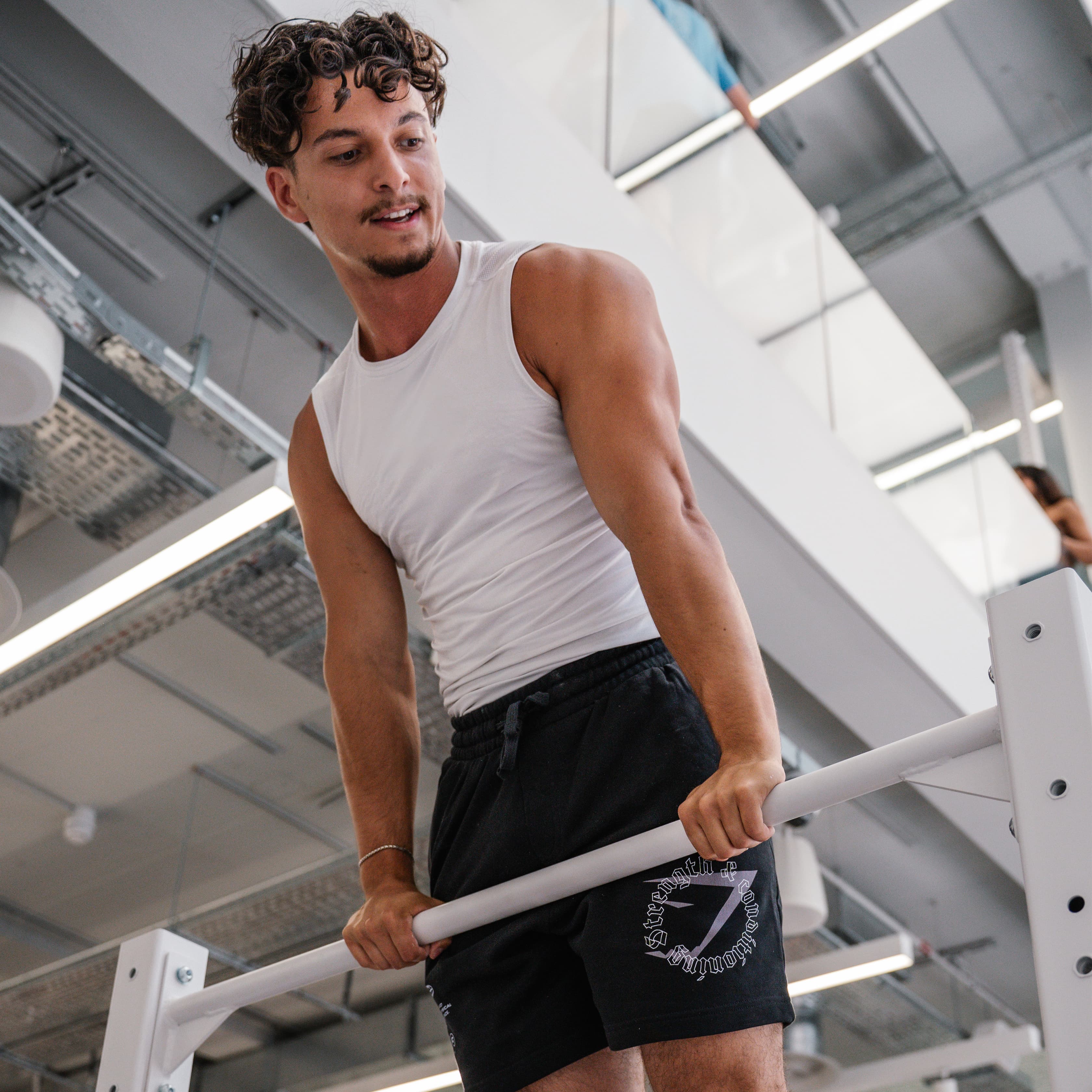
2. Strict Bar Dips
Strict bar dips use your bodyweight to build essential pushing strength, joint stability, and control. Working the chest, shoulders, and triceps, dips build strong muscles that are heavily used in calisthenics exercises such as muscle-ups and planche [3]. Strict dips are also a foundational movement for performing more advanced calisthenics exercises, such as muscle-ups, front lever, and handstand push-ups, teaching the control of pushing from a deep position–so mastering these is essential if you have any of those movements on your radar!
How to do strict bar dips:
Take hold of the parallel bars in an overhand grip, wrists next to your chest. Jump up so your arms are straight and your elbows are locked out. Engage your core and keep your body upright or lean slightly forward.
Lower slowly by bending your elbows to about 90°, keeping them close to your sides.
Pause briefly at the bottom without letting your shoulders collapse. Then, push back up to the starting position by straightening your arms.
Repeat for reps while maintaining strict form and control.
Tip: If you find this exercise too difficult, use a resistance band to help you. Loop the resistance band over the straight bar and pull one end through the other to secure it. Loop the other end over the bar. Then, place both knees into the band and perform your dips the same as the steps above.
This makes the exercise easier, as the band offsets some of your bodyweight. The thicker the band, the more assistance it provides, and you can gradually decrease the thickness of the band you use as you get stronger.
You could also use the assisted dip machine to build strength if you're in a gym.
3. Inverted Rows
Also known as the body row or Australian pull-up, inverted rows build horizontal pulling strength, essential for more advanced calisthenics exercises [4]. Targeting the upper back, lats, biceps, and core, they are an excellent exercise for building strength for pull-ups [5].
Changing the height and body angle of the bar alters the difficulty of the exercise. A higher bar leads to a more upright body position, making the exercise easier, whereas a lower bar and more vertical body position make it more difficult.
How to do inverted rows:
Set up a barbell in the rig at around waist height.
Come behind the bar (inside the rig), and sit down so your legs are stretched out in front of you, underneath the barbell.
Take hold of the bar with an overhand grip, hands just wider than shoulder-width apart.
Lift your hips off the ground, straightening your legs to form a straight line from your feet to your shoulders. Squeeze your glutes, abs, and shoulder blades to create tension in your body.
Pull your chest toward the bar, keeping your elbows close to your side and bringing your chest to touch the bar.
Pause for a second at the top, then slowly lower back down with control, then repeat.
Tip: It can be tempting to let your hips sag, but keep your glutes squeezed throughout the movement to prevent this!
If you find this exercise too difficult with straight legs, start with your knees bent at 90 degrees. Straighten your legs a little more each time, until you have built enough strength to perform inverted rows with your legs fully extended.
4. Pull Ups
Pull-ups target the lats, biceps, upper back, shoulder, and core, building vertical pulling strength, grip strength, and full-body control [6]. They are a base movement essential to master as a foundation for more advanced calisthenics exercises such as muscle-ups and front levers, making them a cornerstone of calisthenics for beginners.
Avoid kipping or using any momentum. Calisthenics movements are all strict (meaning they don’t use any momentum to help move your bodyweight), and performing pull ups in this controlled way increases activation of muscles in the upper body [7].
Aim to master 10 strict pull ups as part of your beginner calisthenics program.
How to do pull ups:
Jump up to the bar (or use a box to step up to the bar) and take hold of it with an overhand grip, shoulder-width apart, knuckles facing the ceiling.
If standing on a box, step down from it so you are in a dead hang, arms extended, shoulders slightly engaged.
Pull up to the bar, driving your elbows back and down (imagine you are trying to squeeze them in towards each other). Lift your chest towards the bar, pulling until your chin comes over the bar.
Pause briefly at the top, then lower down, controlling the descent back to a full hang.
Tip: ‘If doing a full pull up is too difficult,’ says Zach, ‘try a scaled variation, such as ring rows, to build strength. Start with your body more vertical, then walk your feet out a little each session, until you can perform the whole set in an almost horizontal position.’
‘You can also use resistance bands to assist your pull ups–starting heavy, and working your way down as you get stronger. Or, if you’re in a gym, the assisted pull up machine is a good tool.’
5. Handstand Hold
If you’re not used to getting upside down, you’ll soon be used to the feeling after practicing handstand holds a few times. Don’t worry, these don’t need to be freestanding: Practicing handstand holds against the wall will teach you body awareness and control to hold your body weight through your hands. They also train wrist strength and strengthen the shoulders, traps, triceps, and core.
How to do handstand holds (against the wall):
Stand facing a clear wall. Lean down to place your hands on the ground about 30cm from the wall, shoulder-width apart.
Kick one leg, then the other, up to the wall, letting your heels rest lightly against it.
Press your palms into the floor with your arms locked and shoulders pushed up (shrugged). Keep your gaze directly ahead (not looking down at the ground) to keep your spine aligned. Engage your core, glutes, and legs to keep a straight line.
Hold for 10 to 60 seconds.
Push off the wall, bringing one foot then the other back to the ground.
Tip: Start by holding for 10 seconds, gradually increasing the time you hold as you progress. Try repeating in an EMOM (every minute on the minute) pattern, holding for as long as possible, then resting for the remainder of the minute before kicking up again. Alternatively, rest for a set amount of time between reps, e.g., one minute.
If you don’t yet feel confident kicking up to the wall, try a handstand hold off a box. Place your hands on the floor shoulder-width apart just in front of a box to do this. Then, step your feet up onto the box, walking your hands in if necessary, so your hips are stacked over your shoulders and wrists, and your body is in a pike shape.
6. Bodyweight Squats
We’d have a good chance betting you already know these ones, but without them, it wouldn’t be a beginner's calisthenics workout! Bodyweight squats are an essential calisthenics foundation, forming the basis on which every leg exercise is built, so it’s important to take time to master the bodyweight squat with good form and depth. If you want to be able to do cossack squats or pistol squats, you need to master the basics of the bodyweight squat first.
How to do bodyweight squats:
Stand tall with feet shoulder-width apart, toes slightly turned out, and arms in front for balance or hands clasped in front of your chest.
Engage your core and keep your chest up as you begin the movement. Push your hips back like you're sitting in a chair, bend your knees, and lower yourself.
Lower down until your thighs are parallel to the floor (or as low as comfortable), keeping heels on the ground and knees tracking in line with toes.
Drive through your heels to stand back up, squeezing your glutes at the top.
Tip: Pretend you're ripping the floor apart with your feet – As you squat, apply outward pressure through your feet as if you're trying to tear the ground between them. This activates your glutes, keeps your knees tracking properly, and adds stability.
Focus on form and depth with your squats. Keep your chest up, maintain a straight spine, and don’t let your knees cave in. Come down so that your thighs are parallel to the floor. Struggling with mobility? Try these 12 Squat Mobility Exercises.
7. Plank
The final cornerstone of any beginner calisthenic workout is core strength, which is the foundation for nearly every calisthenics movement. A strong core helps with stability and control, balance and coordination, and efficient energy transfer between the upper and lower body [8,9].
The plank is a great exercise for building foundational core strength and balance [10]. Planks target the deep core muscles, critical for stability and control in virtually all calisthenics movements—from push-ups to handstands. They also teach how to properly ‘brace’ your core and develop proper alignment.
How to do a plank:
Start on the floor with your forearms flat and elbows directly under your shoulders.
Extend your legs straight behind you, balancing on your toes.
Engage your core by pulling your belly button toward your spine.
Keep your body straight from head to heels—avoid sagging or arching.
Hold the position while breathing steadily, aiming for 20–60 seconds to start.
Tip: ‘Try out different plank variations,’ advises Zach, ‘Whether that’s a high plank, on your elbows, or a side plank. Both activate the core, but side planks will activate the obliques more, while traditional planks work the rectus abdominis (front abs) and transverse abdominis (deep core).’
‘Switching up your planks ensures you're strengthening all parts of the core and surrounding muscles.’
8. Hollow Holds
The hollow body shape is a base position used in many calisthenics exercises, such as pull ups, handstands, front levers and muscle ups. Learning how to do a hollow hold and effectively brace your core makes this a great foundational exercise to learn as a beginner doing a cali workout.
How to do hollow holds:
Lie on your back with arms extended overhead and legs straight. Flatten your lower back into the floor to engage your core.
Lift your shoulders and legs off the ground a few inches, forming a hollow body shape (curved spine, tucked ribs, flat lower back). Keep arms by your ears, legs together, and toes pointed.
Hold the position, breathing steadily, squeezing your core, and keeping full-body tension.
After holding for 20-60 seconds, relax.
Tip: If this is too difficult, keep your arms by your sides, palms facing down. To make the exercise easier, you could also try bringing one knee into your chest, alternating between legs that are extended halfway through.
Aim to hold for at least 20 seconds, up to 60 seconds, or even more. As with the handstand holds, hollow holds could be performed as an EMOM or using set rest periods between reps.
Tips For How To Start Calisthenics From An Expert
Lifting Club Coach Zach Watson shares his advice for beginners starting callisthenics:
🧘♂️ Focus on mastering the technique, form, and range of motion before adding extra reps or increasing the difficulty of an exercise. ‘Not only will this ensure you develop proper strength, flexibility, and stability needed for more complex calisthenics exercises, but it will give you the confidence to try them, knowing that your body is prepared,’ notes Zach. But don’t do too much too soon–focus on the basics first, and progress gradually.’
🔥 Always warm up properly: Guilty of skipping your warm-up now and then? So are we… but pre-callisthenics, you should always make sure you are properly warmed up to prevent injury and mobilise your body for the movements you are about to do. ‘This could be a yoga mobility flow to open up your back and shoulders, as well as mobilise your hips, or using a light resistance band to warm up the shoulders and upper back.’
🚀 Progress when things start to get comfortable–but don’t rush it: ‘If you can do 3-4 sets of 10-15 reps at RPE 7 or lower, or you feel like you are no longer being challenged, then you can look at progressing or changing that variation.’* That could be bringing your body more horizontally under the bar during an inverted row, or beginning to learn a muscle-up once you’ve mastered strict pull-ups.
🛌 Don’t forget about recovery:‘Callisthenics workouts should be treated exactly the same as you would treat strength training, giving your body enough time between sessions to recover.’ The recovery you need varies per individual, but generally between 24 and 72 hours between sessions targeting the same muscle groups [11].
⏳ Have patience: ‘Just because callisthenics uses bodyweight exercises, doesn’t mean it’s not difficult to do. Learning callisthenics exercises takes time, commitment, and patience. Some movements might be easy to learn; others might take months or years of practice–but that’s the fun of it.’
How To Warm Up For A Calisthenics Workout
1. Raise your heart rate
Starting with a short burst of cardio is a good way to raise your heart rate, get the blood flowing to your muscles, and mentally prepare for your calisthenics workout. This might include 3 to 5 minutes on an erg (such as a ski erg or a bike, which would be preferred over a walk or cycle, as they target upper body muscles as well as those in the lower body).
2. Mobility & Dynamic Stretching
Loosen up the joints and improve active range of motion, especially in the shoulders, wrists, hips, and spine — all crucial in calisthenics.
Zach recommends some dynamic stretching or a yoga mobility flow to ‘open up the back, warm up the shoulders, and mobilize the hips.’
The wrists and shoulders should be a focus during your callisthenics warm-up, with many exercises putting a lot of pressure through the wrists and overhead exercises putting stress through the shoulders. ‘Using a light resistance band is a good way to warm up your shoulders,’ says Zach, ‘Try some pull-aparts, face pulls, and shoulder external rotations, moving through two or three sets of 15 reps each.’
(Discover these Shoulder Prehab Exercises that make a great addition to your callisthenics warm up.)
@calisthenics.bypaulina Do NOT skip your wrist warm up!!🤸🏽♂️ Here’s my go to wrist warmup which I do EVERY SINGLE day! If you’re looking to learn how to handstand, my beginners app offers you a 4 week dedicated handstand program for complete beginners starting with building the strength needed to hold your own weight upside down! It’s the first link in my bio on IG ✅💪🏽 #calisthenics #gymtok #gymmotivation #handstand #wriststretch #wristwarmup #calisthenicsworkout ♬ original sound - calisthenics.bypaulina
3. Activation & Skill-Specific Prep
Think about the muscles and movement patterns you’ll use in your beginner's calisthenics workout and choose exercises targeting those muscle groups.
‘I like to do some alignment drills,’ notes Zach, ‘Particularly if I have handstands, pull ups or muscle ups during my session. This could include doing hollow or superman holds to teach core control, body awareness, and proper posture.’
You might also take your body through some easier versions of exercises you’ll include in your main workout, for example:
Scapular pull ups to warm up for pull ups
Incline push ups to warm up for push ups
Light resistance band rows to warm up for inverted rows
Pike shoulder taps to warm up for handstand holds
What Are The Benefits Of Calisthenics Workouts For Beginners?
Requires Minimal Equipment
Sick of waiting practically the whole time for the leg press to be free? Or maybe you don’t have a gym membership at all. It’s easy to do a basic calisthenics workout at home–all you need is your bodyweight, and ideally a pull-up bar (although this isn’t essential, but can be found at many outdoor gyms).
‘Even if you need extra resistance, you can put books in a backpack, or elevate your hands on a chair to make push ups easier. You can use what you have around you,’ notes Zach.
Adjustable To Any Skill Level
You might picture calisthenics as just for advanced athletes or gymnasts, but cali workouts can be scaled to any skill level, making them accessible to all levels. While you might have the goal of working up to an L-sit, muscle up, or even just a full push up on your toes, there are exercises you can start with to build your way up to more advanced movements.
Effective For Improving Posture, Strength, And Body Composition
It’s true–gains can be made without weights. A 2017 study proved 8 weeks of calisthenics training to be successful at increasing strength, reducing fat mass, and improving posture [1].
‘You probably aren’t going to look like a bodybuilder using calisthenics,’ notes Zach, ‘but it does build overall strength, coordination, and fitness. As your strength progresses, you will need to make the exercise variation more challenging, whether that’s adding resistance with a band or weighted belt, increasing the range of motion, or adding extra reps.’
Provides A Full body Workout
Calisthenics exercises are compound movements that involve multiple muscles. This means you can improve overall strength and hypertrophy in a time-efficient way. ‘You could even add some cardiovascular training, such as burpees or jumping squats, to your calisthenics workout,’ Zach suggests, ‘to build aerobic capacity and strength.’
Trains Mind-Muscle Connection
Callisthenics trains your brain to work hard, as well as your muscles. By forcing you to focus on controlled movements and think about the muscles being worked, calisthenics develops mind-muscle connection, an essential skill for improving muscle activation, growth, and exercise form for both bodyweight and weighted exercises.
‘With weightlifting, it can be easy to concentrate on the weight itself, rather than the movement,’ says Zach. ‘Calisthenics creates greater body awareness, which is transferrable to many other exercises.’
FAQs
How Fit Do You Have to Be Before Starting Calisthenics?
You don’t need a high fitness level to start calisthenics–it’s suitable for those with minimal strength and experience. What you do need is patience, perseverance and commitment. Calisthenics requires strength, body control and core stability, but scaling options mean that anyone can start calisthenics and adjust the exercises according to their level.
Can You Build Muscle With Just Calisthenics Exercises?
Yes–Research has proven this [12]. But you still need to make sure you are challenging your muscles.
‘If it gets too easy,’ notes Zach, ‘you’ll need to add additional load or change the variation.’
Examples of this include:
Choosing a more complex progression, e.g., changing press-ups to decline press-ups.
Adding additional weight, e.g., using a resistance band looped around your back during push-ups to increase the resistance, or using a weighted belt during pull-ups or dips.
Increasing the range of motion e.g. Doing handstand push ups on parallettes, rather than on the floor.
How Often Should You Do Calisthenics Exercises as a Beginner?
This depends on your current workout split and overarching goals, but 1 to 2 times a week is a good aim for beginners starting calisthenics.
Zach notes: ‘The more frequently you do calisthenics training, the quicker you’ll pick it up. If there’s a specific skill you want to master, such as a pull-up or a muscle-up, I’d recommend practicing that skill once or twice a week.’
‘That being said, don’t do too much too soon, and always give your body enough time to recover, just as you would for strength training.’
How Can I Split My Training to Include Callisthenics Workouts Alongside Lifting?
There are two main options to build a calisthenics workout routine:
Sprinkle some calisthenics exercises into your current workout split: This might involve adding some calisthenics exercises into supersets with weightlifting exercises, or taking 15 minutes at the end of your strength workout to do some calisthenics exercises.
Do one or two full calisthenics days instead of a current lifting day: Many people like to replace their upper body weighted day with calisthenics training, utilizing bodyweight movements to build upper strength.
Note: You might need to reduce some of your strength training when adding calisthenics to avoid overtraining. Always think about your total weekly volume: If you’re adding calisthenics into days that were previously rest days, or you’re doing your regular hour of strength training and then 30 minutes extra calisthenics on top, you may be doing too much. Symptoms of overtraining include fatigue, lack of motivation for training, poor recovery/muscle soreness, and trouble sleeping [13].
How Long Does It Take to Master Beginner Calisthenics Exercises?
This depends on the individual and your current fitness and skill level! Everyone should be able to pick up the foundational calisthenics exercises (squats, push ups, pull ups, or at least a variation of these) within a few months–but for some it may take longer than this. To master more advanced calisthenics movements (handstand push ups, l-sit, muscle up) could take a year or longer of consistent practice. Movements such as planche and human flag are advanced and require extremely high strength, balance, and coordination.
The most important thing is not to be put off by how long it can take to learn calisthenics exercises. Have patience and start with the basics, and over time, you will see progress.
Do I Need a Gym or Can I Do Calisthenics Exercises From Home?
You can easily do a basic calisthenics workout from home, which is what makes this type of exercise so great. All you need is your bodyweight and some space, but having the following basic equipment can come in useful:
Resistance bands (to make exercises easier or harder)
Paralettes (allow for a deeper range of motion on exercises such as push ups and handstand push ups, and can be a more comfortable position on the wrists.)
A raised surface, such as a couch or bed (this can be used to create an incline or decline for push ups).
Pull ups are probably the only exercise that is tricky to do at home (which is why some people seek out an outdoor gym for these if they don’t have a gym membership). However, you can get a pull up frame to hang over a doorway–just make sure your doorway is sturdy enough first to support your weight!
Your Gateway To Callisthenics Training
These beginner callisthenics exercises may look simple, but they lay the foundation for every more advanced movement.
‘All too often, people overlook the basics of calisthenics. You might want to skip straight to the more fancy movements, but these aren’t the starting point,’ says Coach Zach.
‘If you can master these basics and get very good at them, you’ll have a strong starting base to progress onto other exercises.’
Be patient, focus on form and stick with it–You’ll be surprised how far some body weight training can get you.
*RPE refers the to rate of perceived exertion. This is a measure based on feel of how hard your body is working duration of a given activity. On a scale of 1 to 10, 1 is no effort (such as sitting down), 2-3 (minimal effort), 4-6 (moderate effort), 7-8 (hard), and 9-10 (threshold to max effort).
References:
Thomas, E., Antonino Bianco, Esamuela Pieretta Mancuso and Palma, A. (2017). *The effects of a calisthenics training intervention on posture, strength and body composition.*
Kikuchi, N. and Nakazato, K. (2017). Low-load bench press and push-up induce similar muscle hypertrophy and strength gain.
McKenzie, A., Crowley-McHattan, Z., Meir, R., Whitting, J. and Volschenk, W. (2022). Bench, Bar, and Ring Dips: Do Kinematics and Muscle Activity Differ?
Ronai, P. and Scibek, E. (2014). The Inverted Row. Strength & Conditioning Journal, 36(4), pp.94–97. doi:https://doi.org/10.1519/ssc.0000000000000070.
Fenwick, C.M.J., Brown, S.H.M. and McGill, S.M. (2009). Comparison of Different Rowing Exercises: Trunk Muscle Activation and Lumbar Spine Motion, Load, and Stiffness.
Ronai, P. and Scibek, E. (2014b). The Pull-up. Strength & Conditioning Journal, [online] 36(3), pp.88–90. doi:https://doi.org/10.1519/SSC.0000000000000052.
Williamson, T. (2021). A comparison of muscle activity between strict, kipping and butterfly pull-ups.
Oliver, G.D. and Adams-Blair, H.R. (2010). Improving Core Strength to Prevent Injury.
Rivera, C.E. (2016). Core and Lumbopelvic Stabilization in Runners.
Miftachul Amiruddin, Oce Wiriawan and Muhammad, M. (2023). Strength and Balance Improvement with Plank Exercise Variations.
Lopes, C.R., Brigatto, F.A., Camargo, J.B.B. de, Germano, M.D., Marchetti, P.H., Aoki, M.S. and Politano, H. (2023). Effects of resistance training on consecutive and non-consecutive days on hormonal, neuromuscular and morphological responses in recreationally trained men.
Kotarsky, Christopher, J., Christensen, Bryan, K., Miller, Jason, S., Hackney and Kyle, J. (2017). Effect of Progressive Calisthenic Push-Up Training On Muscle Strength and Thickness.
Kreher, J.B. and Schwartz, J.B. (2012). Overtraining Syndrome.