

















Ever tried a sports bra in two different sizes and neither felt right?
One feels too tight around your ribs, but the next size up suddenly feels loose and unsupportive. Or the cups finally fit, but the band won’t stay in place.
It’s a common problem, and it’s usually not about needing a completely different size; it’s about understanding how bra sizing actually works. In fact, around 80% of women wear the wrong bra size [1]. Not because they haven’t tried different styles and brands, but because bra sizing isn’t as simple as it looks.
Sister sizing offers a smart solution. Instead of treating your size as fixed, think of it as something you can shift slightly, adjusting the band and cup together to get a better fit.
In this guide, we’ll break down how bra sizing really works and show you how to use sister sizing in practice, so your sports bra fits properly and supports you for days you train, and rest.
What Is Sister Sizing?
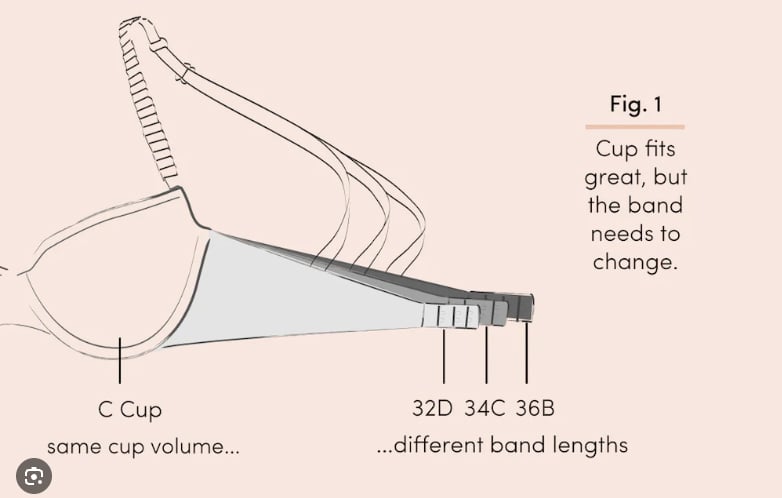
Definition: Sister sizes are different bra sizes that share the same cup volume, but have different band sizes.
For example:
34C
32D
36B
All three hold the same amount of volume in the cup. The difference is how the band fits around your body.
To better understand this, we spoke to Gymshark bra-fit expert Nicki Hall from our product development team.
“The bit most people get wrong is that cup size isn’t fixed. So a C cup doesn’t represent one exact volume across every size; it scales up or down with the band. That’s why when you move between sizes like 34C, 32D, and 36B, the cup capacity stays consistent, even though the label changes.” - Nicki Hall, Gymshark Product Developer
Why Sister Sizing Exists
Because bodies don’t sit neatly within a size chart.
The fit of a bra isn’t just about your measurements; it’s also shaped by how a bra is designed and what it's for.
Some bras run tighter, especially high-support styles, because they’re built to reduce movement using firmer bands and more compressive fabrics to hold everything in place during exercise. That added structure can make the band feel more restrictive compared to softer, lower-support styles. Other bras might feel softer and more flexible if they’re for everyday wear or lounging.
At the same time, your body also shifts over time. Changes from training, especially building muscle in your back, can affect how your band fits. Hormonal fluctuations can also change how full your chest feels, and even small shifts in weight can make your normal size feel slightly off.
Nicki explains how you can manage this, saying, “A lot of people tend to just squeeze into the same size, even if their body has changed slightly - whether it’s through losing or gaining weight. If your bras start to feel uncomfortable, that’s usually a sign you need to get refitted, even if it’s only a couple of months down the line.”
In practice, this is where sister sizing comes in. It gives you a way to adjust your size without starting from scratch every time something feels slightly off. Here’s what to do:
If your back feels tighter than usual, go up a band and down a cup
If your chest feels too full for the bra, go up a cup size and keep the same band
What does this mean for you?
If your usual size feels slightly off, you don’t always need a completely different size.
You might just need the same cup volume with a tighter or looser band. That’s exactly what sister sizing helps you do.
TLDR: The cup volume stays the same, even though the letter changes.
How Bra Sizing Actually Works (And How To Adjust It)
Band Size
Your band size is based on your ribcage. It should sit level around your body and feel secure, as this is where most of your support comes from.
If the band isn’t right, the rest of the bra won’t feel right either. Everything else has to compensate, and that’s usually when straps start digging in or slipping off.
Getting your band size right starts with your ribcage measurement. As Gymshark’s bra fit expert Nicki Hall explains:
“You need to measure firmly around your ribs. You’re not just measuring the flesh; the tape should be snug, so you get an accurate base measurement.”
When to change your band size:
If your band feels tight or restrictive, but the cups feel fine → go up a band and down a cup
If your band rides up or shifts when you move → go down a band and up a cup
Cup Size
Cup size is the measure of breast volume determined by the difference between the fullest part of your bust and your band measurement. This isn’t a fixed volume; it changes depending on the band size.
When to change your cup size:
If the cups feel too small or you’re spilling out → you likely need more cup volume
If the cups gape or feel empty → you likely need less cup volume
You can use sister sizing to adjust without affecting the band more than necessary.
Bringing It Together
The key thing to know is that the band and cup work as a pair.
For example, if you’re wearing a 34C and the band feels too tight, simply going up to a 36C won’t work. The band will feel better, but the cups will now be too big.
Instead, you’d go to a 36B. Same cup volume, better band fit.
Just remember that if you change one without adjusting the other, the fit will become unbalanced. Sister sizing keeps them in sync, so the overall fit stays consistent, even as your body changes.
What If the Same Size Feels Different Across Styles?
You’re not imagining it. Not all bras fit the same, even in the same size. High-support sports bras often feel tighter because of compression, and softer or seamless styles can feel more flexible. That same size won’t feel identical across every design, but you can use sister sizing to figure out where you sit if you’re trying a new brand or style of bra.
How To Find Your Sister Size
To find your sister size, start with what already works:
Put on your current size
Work out what feels off, the band or the cups
Adjust using this rule:
Tight band → go up a band, down a cup
Loose band → go down a band, up a cup
If you’re unsure, try both options and see which feels better
If you can get the perfect fit first time, brilliant, but if not, this will at least help to get a better fit.
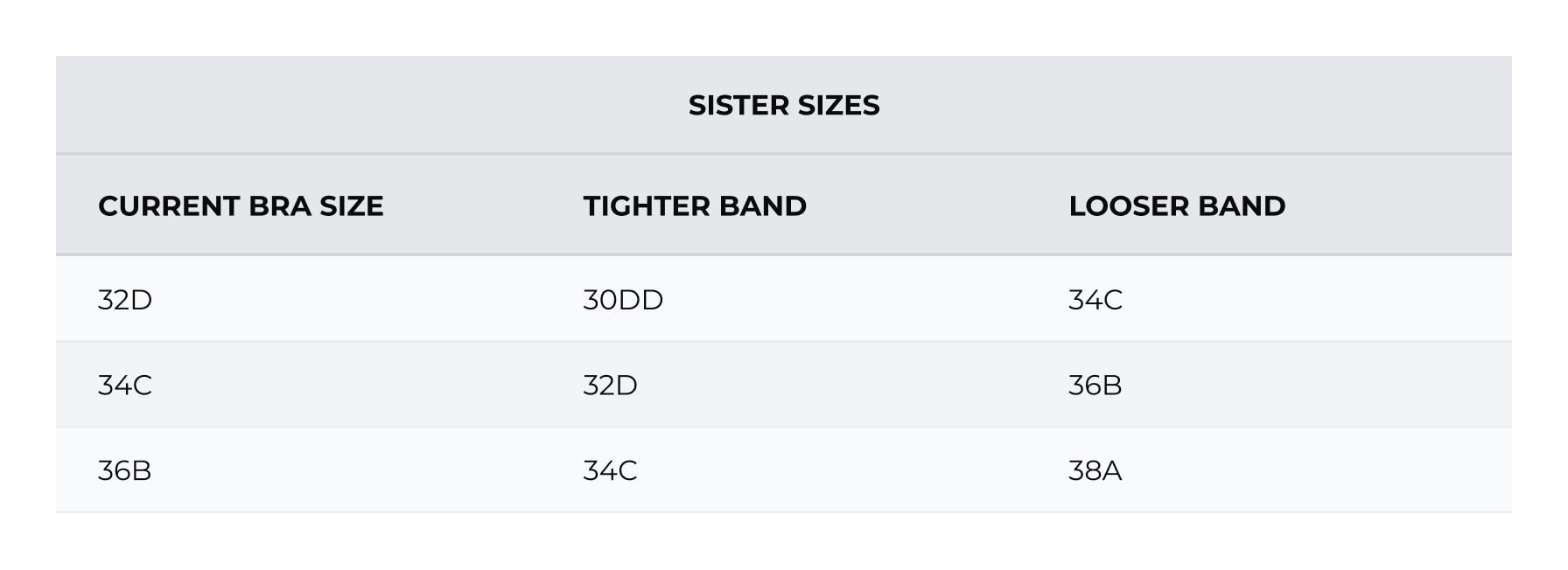
Quick Reference Example
Use this table to know what to do if you know your size and just need a quick adjustment:
Sister Sizing for Sports Bras
Sister sizing only works with sports bras that use band and cup sizing (for example, 32D, 34C). These are often called dual-sized or cup-sized sports bras. This type of sports bra gives you more control as you can tighten or loosen the band without affecting cup volume, adjust the cup size without losing support, and get a more customized fit.
What About Small, Medium, Large?
Sports bras sized S, M, and L (alpha sizing) don’t support sister sizing in the same way.
That’s because they group a range of sizes together. For example, a Medium might cover several band and cup combinations. When you move from a Small to a Medium, you’re changing the band, the cup, and the overall fit all at once and there’s less room to get a custom-fit.
How To Adjust The Fit In Alpha Sizing
Even without exact sister sizes, you can still find a better fit by making small practical adjustments. It’s best to start by finding a style you like and trying multiple sizes side by side, as recommended by Nicki.
“If you’re not 100% sure of your sizing, try your usual size, then the size up and the size down. Try on all three until you find the one that fits the best - that’s the alpha sizing version of sister sizing.”
From there, there are ways you can refit the fit even further.
Try removing the padding if the fit feels too tight through the chest to create a bit more room. This is only recommended for smaller busts who need less support and low-impact movement.
If it feels too loose around your back and shoulders, use adjustable straps or back fastenings are your best friend for getting a closer fit.
Choose the bra based on your workout: more support for high-impact, more flexibility for lower-impact. This will help you get a better fit even if you can’t change the band or cup size.
Note: Alpha sizing (S, M, L) works well for lower-impact training or when comfort and flexibility are the priority. Dual sizing works best when you want a more precise fit or need optimal support for higher-impact training.
Why Sports Bras Fit Differently
You Need More Support From Them
Your breasts need extra support and protection during movement, and because of this, sports bras can look and feel different from everyday bras.
For one, sports bras very rarely feature underwiring and use compressive fabric as explained earlier. Movement and sweat can also change how a bra feels during a workout.
Many wearers like to go up or down a size on their sports bras to find the right fit to match their cup size. Start with your measured size, but don't hesitate to go down one band size if you need more support, or up if the bra is restricting your breathing.
When to Use Sister Sizes for Sports Bras:
If your running sports bra feels too tight around your ribs, try going up a band and down a cup.
If your low-impact sports bra feels like it shifts or lacks support, try going down a band and up a cup.
How To Know If Your Sports Bra Fits Correctly
A well-fitting sports bra should feel secure without being restrictive.
Use this checklist:
The band sits flat and stays in place
You can fit two fingers under the band comfortably
The cups fully contain your chest (no overspilling)
The straps feel supportive without digging in
The centre sits flat against your chest, if the style has one
FAQs
Does sister sizing actually work?
Yes, sister sizing works to give you a better-fitting bra, especially when there’s just one thing that feels off. It keeps the same cup volume while adjusting the band, so if your issue is only with how tight or loose the band feels, it’s a reliable way to improve the fit without changing how the cups sit.
How many different bras should I have?
Our expert Nicki weighs in on this one: “Different workouts call for different levels of support. Ideally, your sports bra rotation should reflect that.” As Nicki notes, “you’re not just buying one bra for everything; you might need different fits for running, strength training, or lower-impact sessions”. She comments that “it wouldn’t be out of the ordinary to have 10 different bras for various activities and occasions throughout the year.”
Is 34D a sister size to 36C?
Yes. They have the same cup volume; the difference is the band fit. 34D will feel tighter around your ribs, 36C will feel looser. So if 34D feels too restrictive, the next size to try would be a 36C.
Does 32A have a sister size?
It does. Every bra has a sister size. For 32A, the closest sizes going down and up band sizes would be:
30B (tighter band)
34AA (looser band)
Is it okay to wear a sister size instead of your regular size?
It’s fine to wear a sister size smaller or larger than your regular size as long as it fits properly. If you’re a 32C and you only have a 34B bra available, you’re fine to wear it as long as it fits well and feels comfortable; that’s what matters. A lot of us are in-between band sizes anyway, or might find we fit differently between brands. It’s the fit and support that matter more than the label.
Does my clothing size match my sports bra size?
Not always. Nicki explains, “Just because you’re a size small in your gym clothes, that doesn’t mean that translates to your bra size.”
Bra sizing is based on your ribcage and bust measurements, not general clothing size. That’s why it’s worth checking your measurements rather than relying on what you usually wear.
References:
[1] 2022. Research Group in Breast Health. [online] Available at: https://www.port.ac.uk/research/research-centres-and-groups/research-group-in-breast-health [Accessed 18 October 2022].